How to Track AWS Exam Prep Progress: A Professional Data-Driven Guide
27 Jun 2026 · 10 min read

Most AWS candidates can tell you how many hours they studied this week. Far fewer can tell you which service domains are still below target, whether their mock scores are trending up, or if they are ready to book the real exam with confidence.
That gap matters. AWS certifications are scenario-heavy. Passing is less about memorising bullet points and more about recognising patterns under time pressure. Without performance data, you are guessing—and guessing is expensive when exam fees and preparation time add up.
This guide explains how to track AWS exam prep like a professional learning programme: measurable outcomes, domain-level visibility, and mock exams that produce actionable feedback.
Key takeaways
- Effort is not progress. Hours watched or pages read only matter if they improve measurable outcomes.
- Domain breakdowns are essential. AWS exams are weighted across services and design themes—you need scores per area, not one headline number.
- Mock exams are your baseline and your trend line. Use them to establish a starting point and to verify improvement over time.
- Explanation quality reveals depth. Knowing the correct letter is not enough; you must understand why alternatives fail.
- Set explicit readiness thresholds before you schedule the official exam—for example, consistent passes at or above your target score across multiple attempts.
The difference between studying and professional exam programme tracking
Why professionals need performance data
When preparation is effort-based, the question is always vague: “Am I ready yet?” You might feel confident after a video course, then discover under exam conditions that you cannot connect services in realistic scenarios.
Data-driven tracking replaces that feeling with evidence:
- Which domains score below your pass threshold?
- Are mock scores stable or volatile across attempts?
- Do you slow down on long scenario stems?
- After reviewing explanations, do the same mistake types disappear?
The old way vs the new way
The old way (effort-based): track hours, finish a course, take one practice test, book the exam when the date feels close.
The new way (data-driven): establish a baseline mock, set domain targets, run timed practice regularly, review explanations systematically, and book the exam only when metrics stay above threshold for multiple attempts.
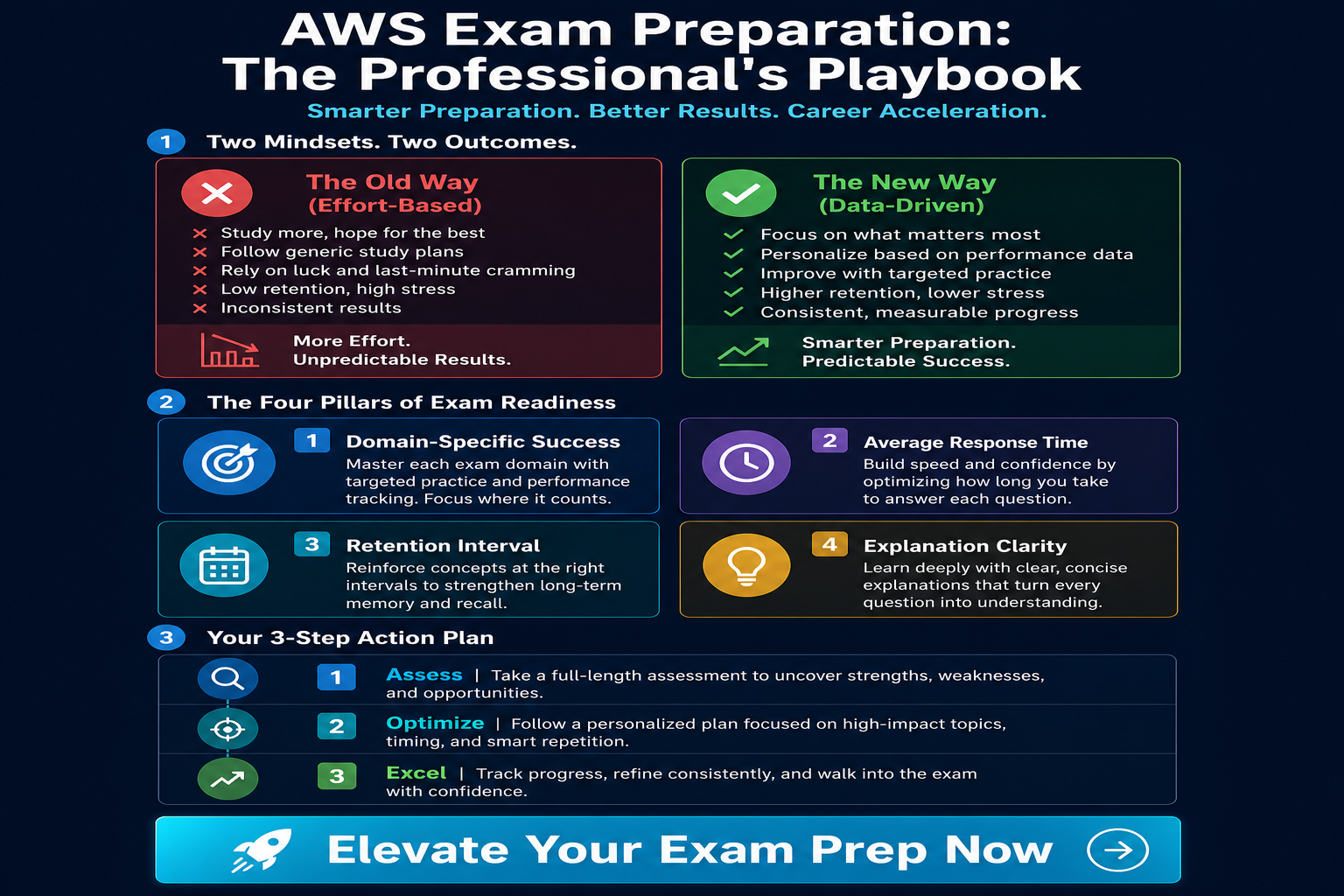
The four pillars of exam readiness
1. Domain-specific success
AWS exams are not monolithic. Whether you are preparing for Cloud Practitioner, Developer Associate, SysOps, or Professional-level certifications, questions cluster around service domains—security, networking, compute, storage, cost, reliability, and architecture trade-offs.
Track performance per domain, not only your total score. A 78% overall with 55% in security is a fail waiting to happen if security is heavily weighted in your sitting.
2. Average response time
Time pressure changes decision quality. Note how long you spend on:
- Short recall items
- Multi-paragraph scenario questions
- Questions that require eliminating two plausible distractors
If your accuracy is good untimed but collapses under a clock, your programme needs more timed practice—not more passive reading.
3. Retention interval
Cramming produces spikes that fade. Space mock attempts and light review sessions so you can see whether knowledge sticks after a few days. A score that jumps after one intensive weekend, then drops a week later, signals shallow retention.
4. Explanation clarity
After each mock, rank your misses:
- Concept gap — you did not know the topic
- Misread — you rushed or missed a constraint in the stem
- Trap sensitivity — you chose a plausible but wrong option
If most misses are concept gaps in the same domain, that domain becomes your next study sprint—not another random chapter.
How to organise your exam progress tracking framework
Step 1: Establish a baseline
Take a full-length timed mock under exam-like conditions. Record total score, domain breakdown, and time per question. This is your day-zero snapshot. Do not tune your plan before you have it.
Step 2: Set specific targets
Define numeric goals—for example:
- Overall mock score at or above 80% on three consecutive attempts
- No domain below 70%
- Completion within the official time limit with five minutes remaining
Adjust thresholds to match the exam level you are targeting. Professional exams often demand tighter consistency.
Step 3: Run integrated exam simulators
Use practice platforms that mirror exam constraints: timed sessions, scenario-based stems, and explanations after submission. Random quiz apps without review mode do not produce the feedback loop you need.
Step 4: Review misses in batches
Group incorrect answers by domain and mistake type. Fix one domain cluster at a time instead of scattering attention across every AWS service simultaneously.
Step 5: Iterate and refine continuously
Every two or three mocks, compare trends:
- Is your weakest domain improving?
- Are misreads decreasing (suggesting better exam technique)?
- Are you seeing the same services repeat as weak spots?
If a domain plateaus, change the input—hands-on lab, focused flash review, or a smaller set of deep scenario questions—not more passive video hours.
The benefits of integrated exam simulators
Standalone question dumps and unstructured quizzes fail for three predictable reasons:
- No exam rhythm — you never practice pacing across a full session.
- No explanation loop — you mark wrong answers but do not build mental models.
- No history — you cannot see trends across attempts.
Integrated simulators tie timing, scoring, domain tagging, and review into one workflow. That is what makes progress visible.
On Exambasics, AWS practice exams are designed around this loop: timed attempts, scored results, and explanations that help you understand why an answer fits the scenario—not just which option was labelled correct.
Achieving technical maturity through performance data
Technical maturity in certification prep means you can defend your readiness with numbers:
- “I am scoring 82–86% on timed mocks.”
- “Security was 61% three weeks ago; it is 76% now.”
- “My misread rate dropped after I started underlining constraints in stems.”
That language is what hiring managers and engineering leads recognise—not “I finished a 40-hour course.”
Performance data also reduces anxiety on exam day. You are not hoping you studied enough; you have evidence that your process works under pressure.
Frequently asked questions
How many mock exams should I take before the real AWS exam?
There is no universal number. Use a readiness rule instead: hit your score and domain thresholds on multiple consecutive timed mocks, with at least a few days between attempts to test retention. For many candidates, that means three to six full mocks after initial study—not one practice test the night before.
Should I track study hours at all?
Hours are useful for scheduling, not for readiness. Log them if you want accountability, but never substitute hours for domain scores and mock trends.
What is a realistic target score on practice exams?
Many candidates aim for roughly 80% or higher on quality practice material before booking the official exam, with no critically weak domain. Practice exams are not identical to the live exam, so use targets as a consistent internal standard—not a guarantee.
How do I know if my practice questions are good quality?
Strong practice content uses scenario-based stems, plausible distractors, and explanations that teach the underlying design principle. If explanations feel like trivia or copy official exam wording, treat that material cautiously. Independent practice platforms should be original and focused on learning—not memorising leaked items.
Can I track progress without expensive tools?
Yes. A spreadsheet with domain scores per mock works. The advantage of integrated platforms is automation: history, timing, and review mode without manual data entry. Choose the lightest tool you will actually use every week.
When should I book the official exam?
Book when your metrics have been stable above threshold for multiple attempts and your weakest domain is no longer an outlier. If scores are still climbing quickly, wait—you are in the steepest part of the curve and more ROI is available from practice.
Closing thought
AWS certification success is not a mystery. It is a measurement problem. Establish a baseline, track domains, respect time pressure, and use mock exams as structured experiments—not one-off rituals. When the data says you are ready, schedule the exam with confidence.
When you are ready to put this framework into practice, start a timed mock on Exambasics AWS practice exams and use your first results as the baseline everything else builds on.


